
Victory 7 TCG Gamebook & Rulings
Preface, A quick note on “evil” gameplay:
The intent is not to desire to do evil to the other players in the game, but for us to understand (as players) that evil exists in life and how we may be able to overcome evil with directly scripturally-derived concepts on cards. There has been quite a bit of thought and prayer which has gone out in implementing the best way to reveal these realities within the game. Thank you for reading.
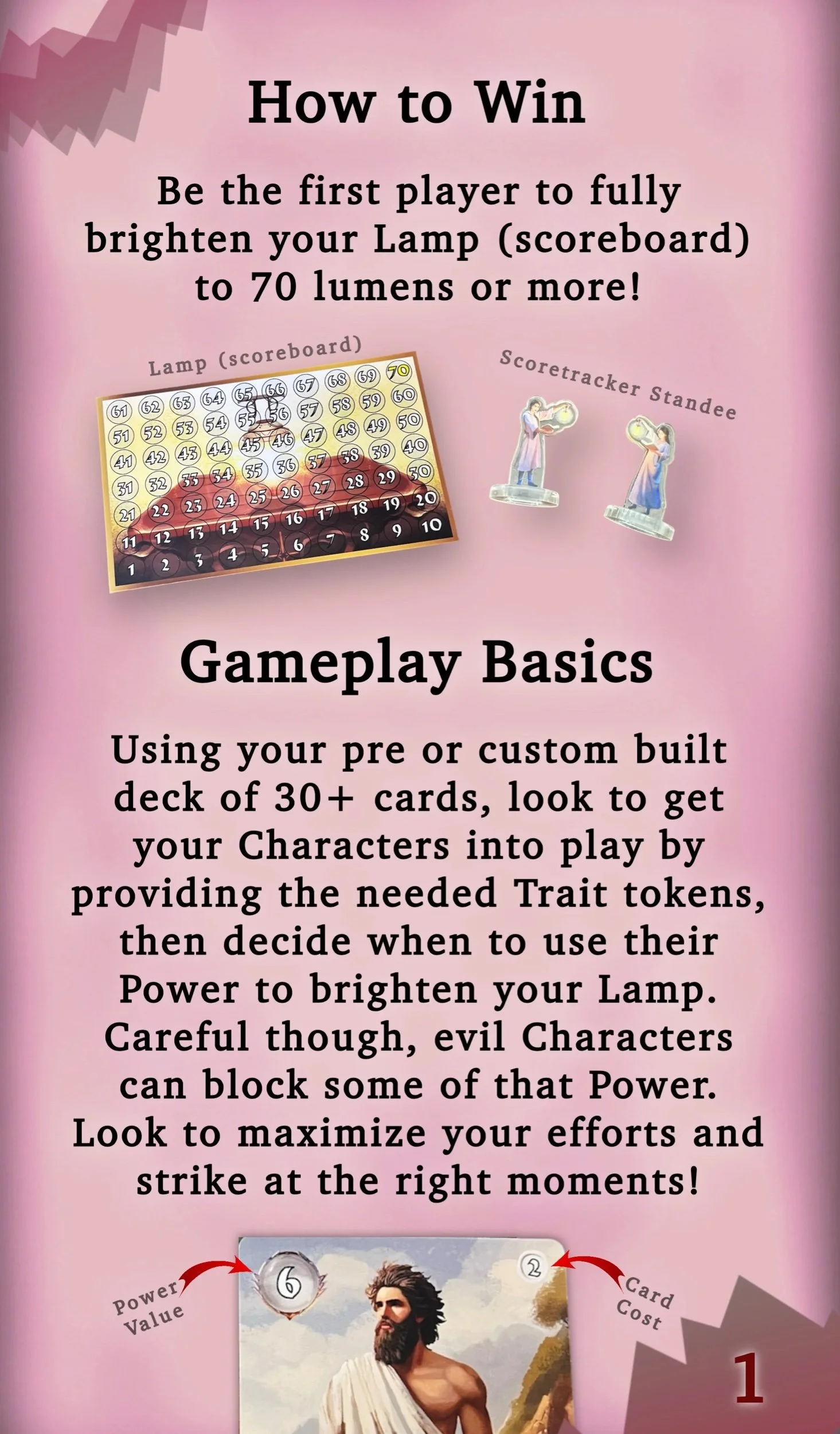
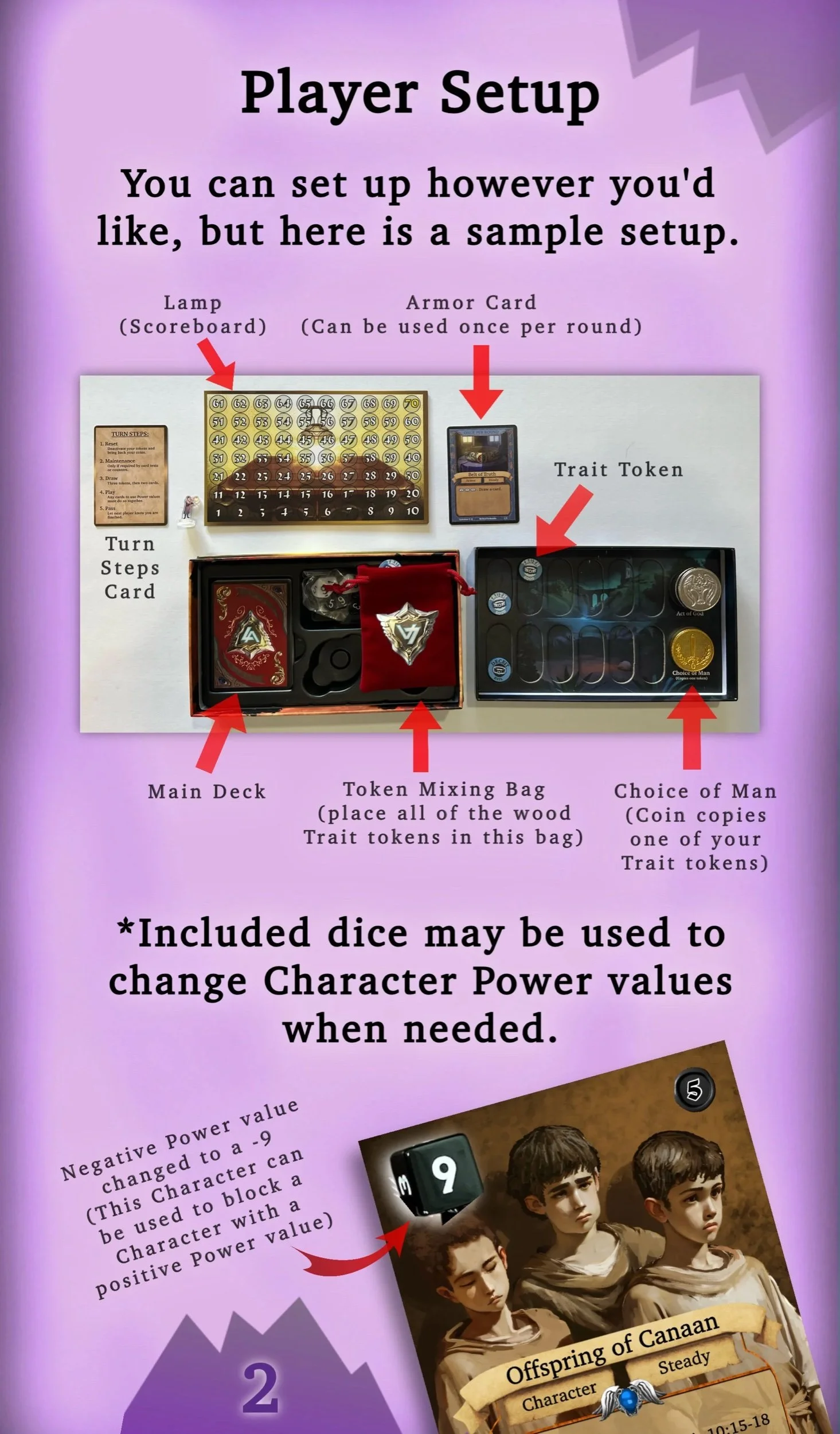
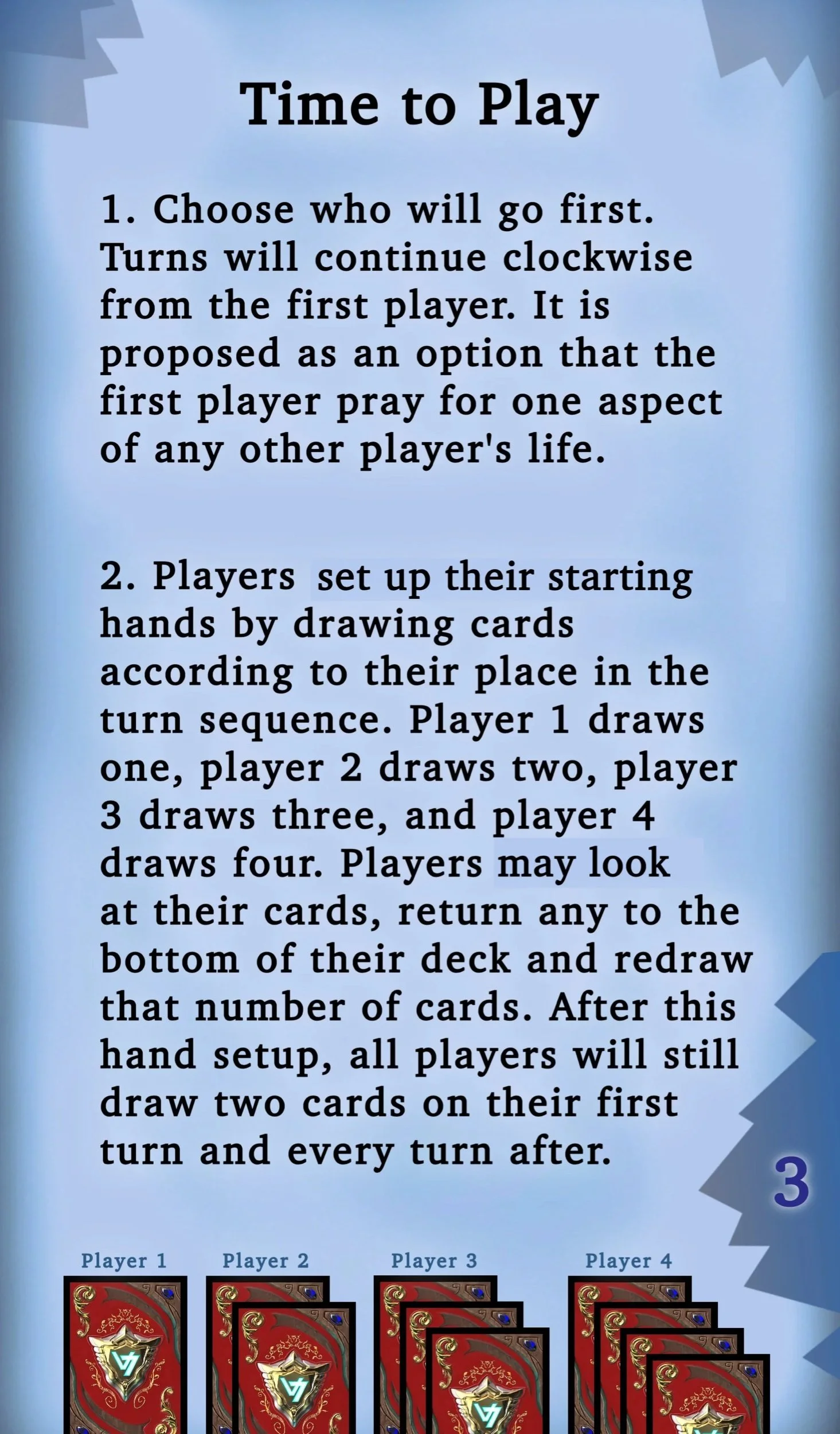
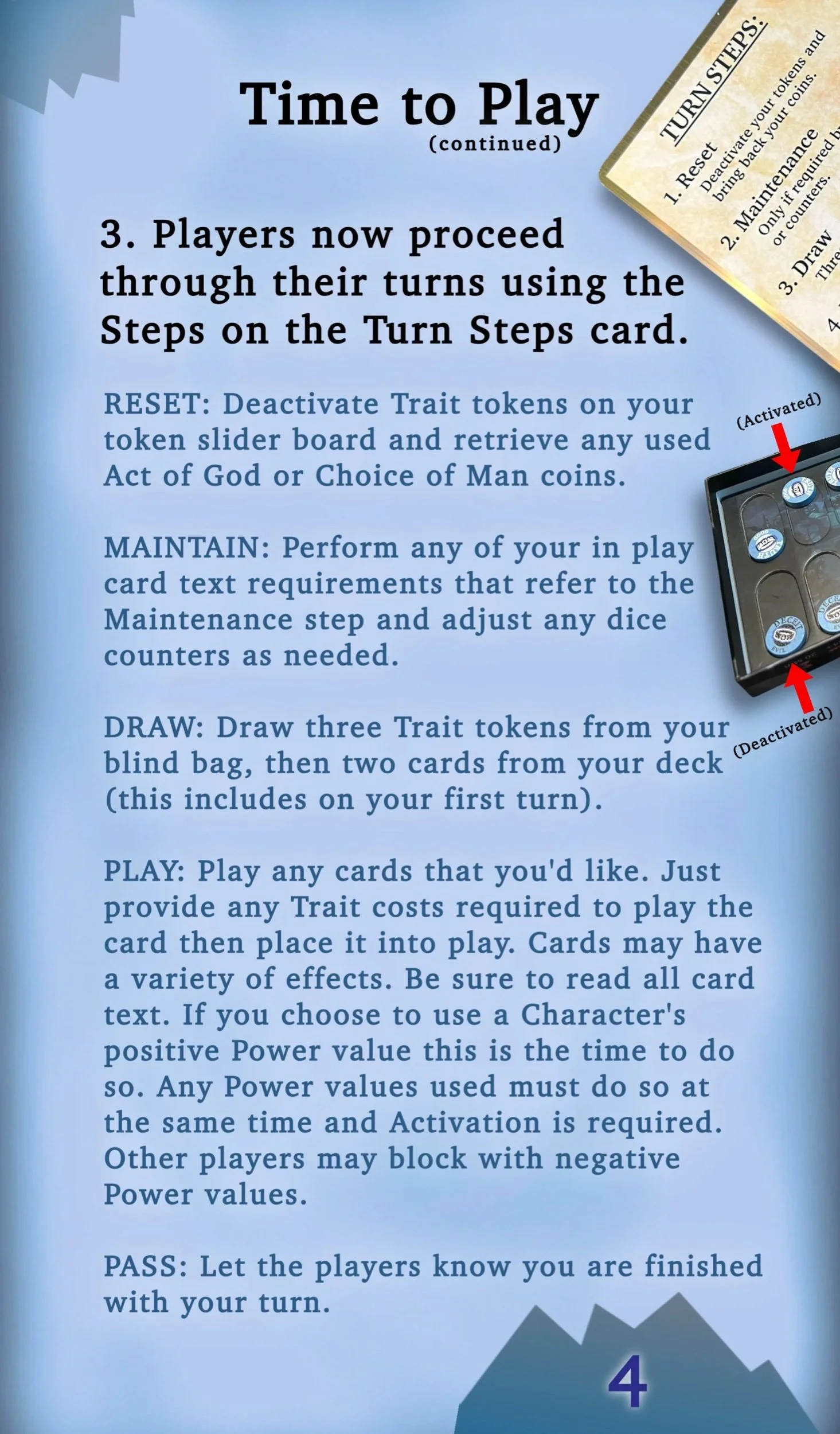
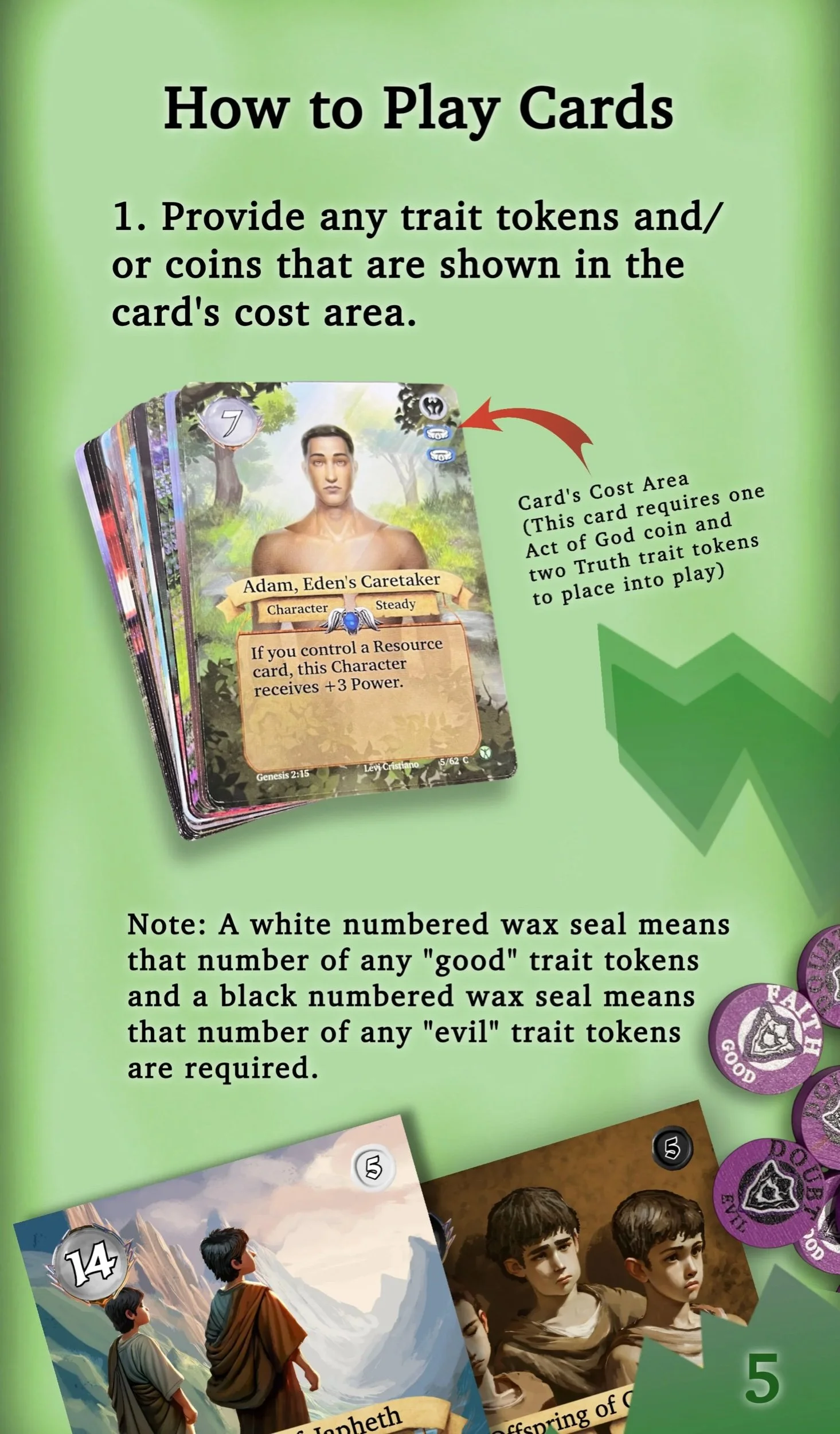
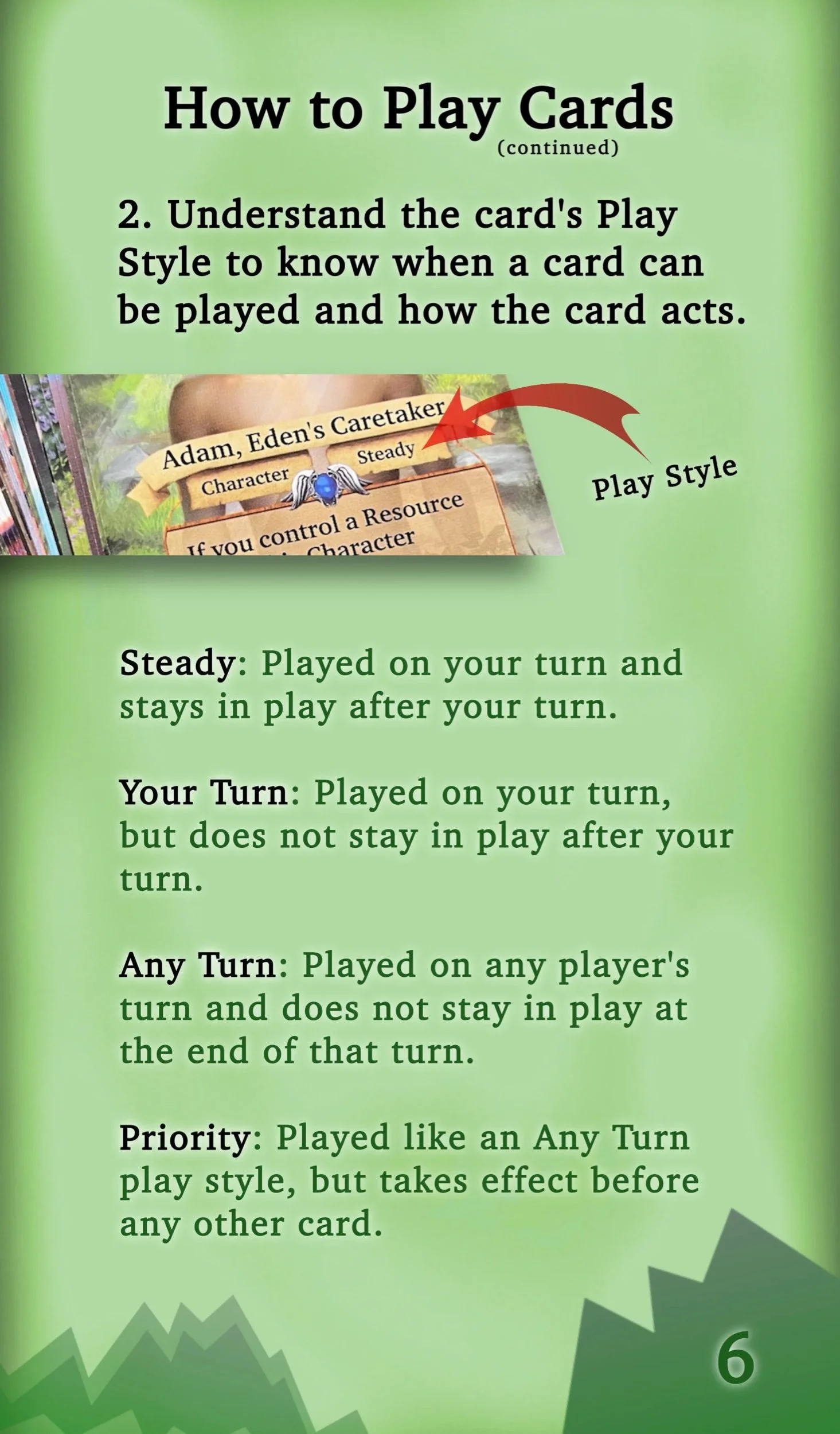
*PLEASE NOTE: At some point I will be adding a how to modify & build decks section. For now, follow these simple parameters:
30-40 card deck (not including Armor card)
No more than three copies of any card
12 trait tokens total in blind bag; six of them being “good” and six being “evil”
Players may have a Shelf of up to 10 cards and six trait tokens (the “Shelf” is considered game items set aside above and beyond from your main items which can be used to exchange/add in between games)
More…
General:
Ability Box Bible Verses: These inserted verses are used to identify a Character and are not associated with the verses listed on the bottom of any card. The in text verses are there in the case there are two different biblically referenced Characters that have the same first name.
Card Bottom Bible Verses: These verses are where the card title is drawn from and have no affect on in ability text box verses; the two are unrelated.
Genders: Characters have a gender that is associated with each. The gender is based on the biological biblical understanding. If a Character's title is ambiguous, then the gender may be as well. For example, Adam is a male and Eve is a female. "Humankind, in God's Image" is either/both because the title is biblically referencing either/both.
Facedown cards keep their card title. Because of this, Build cards may be used on a facedown card.
Activations/Activating:
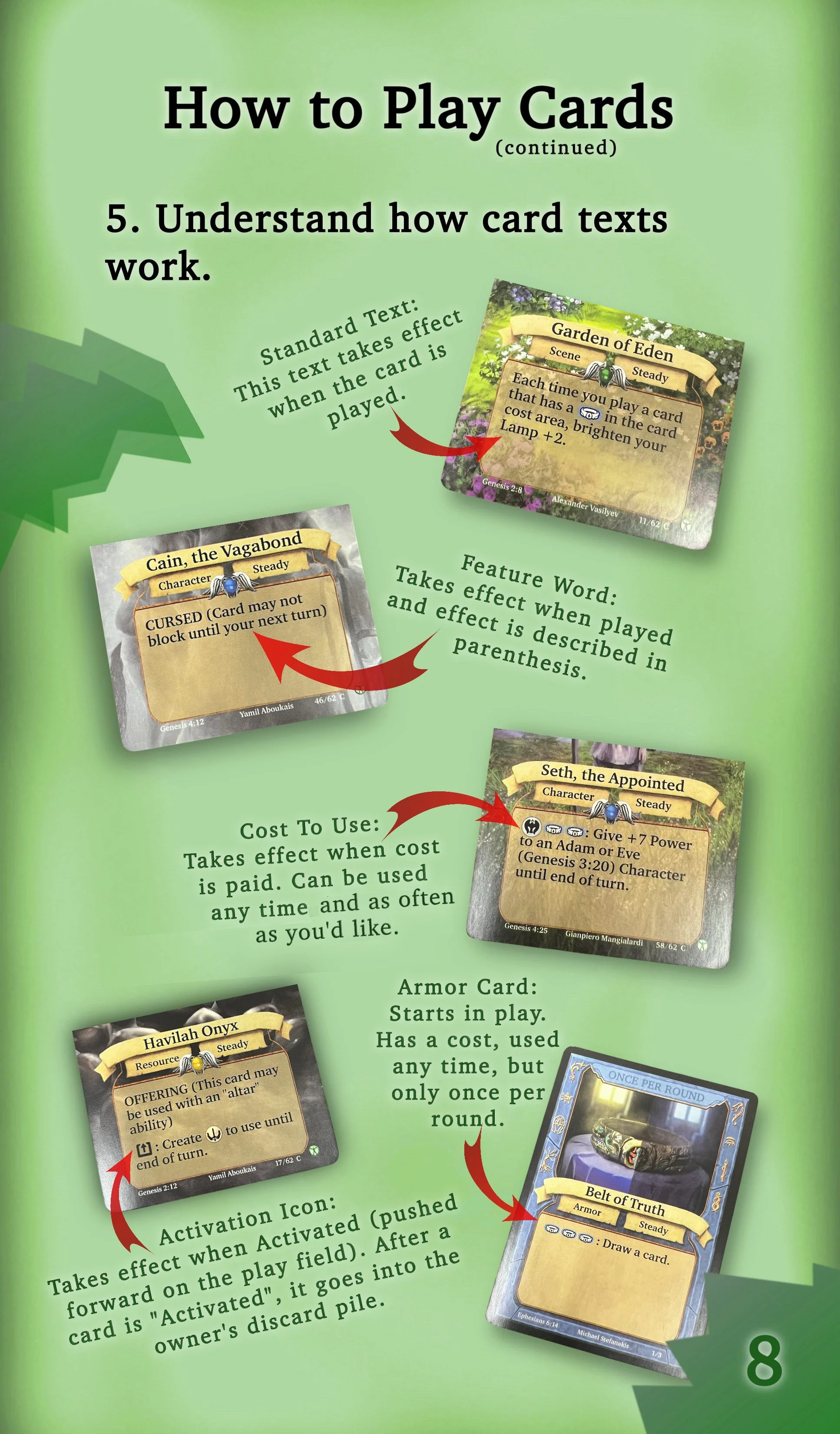
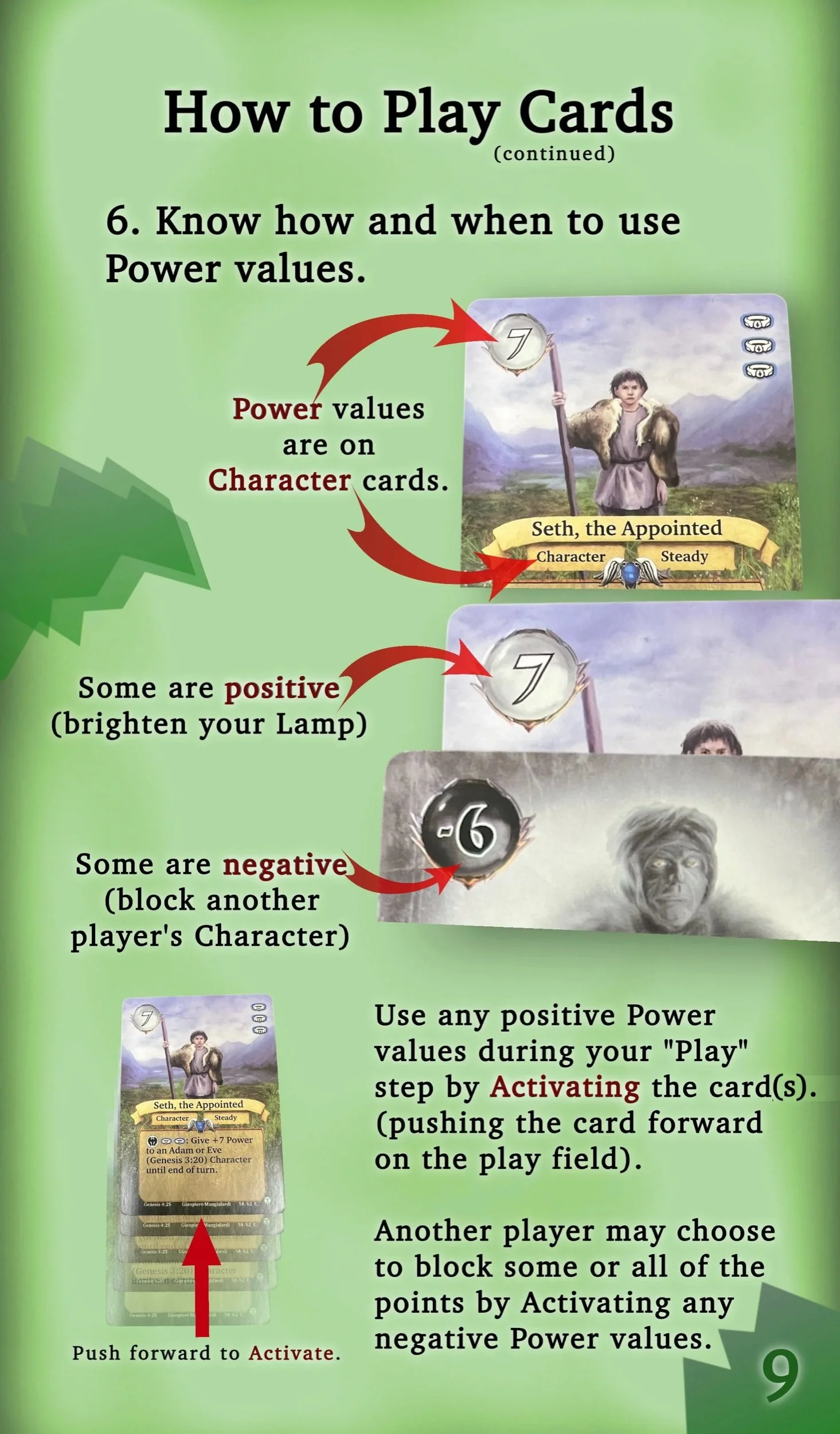
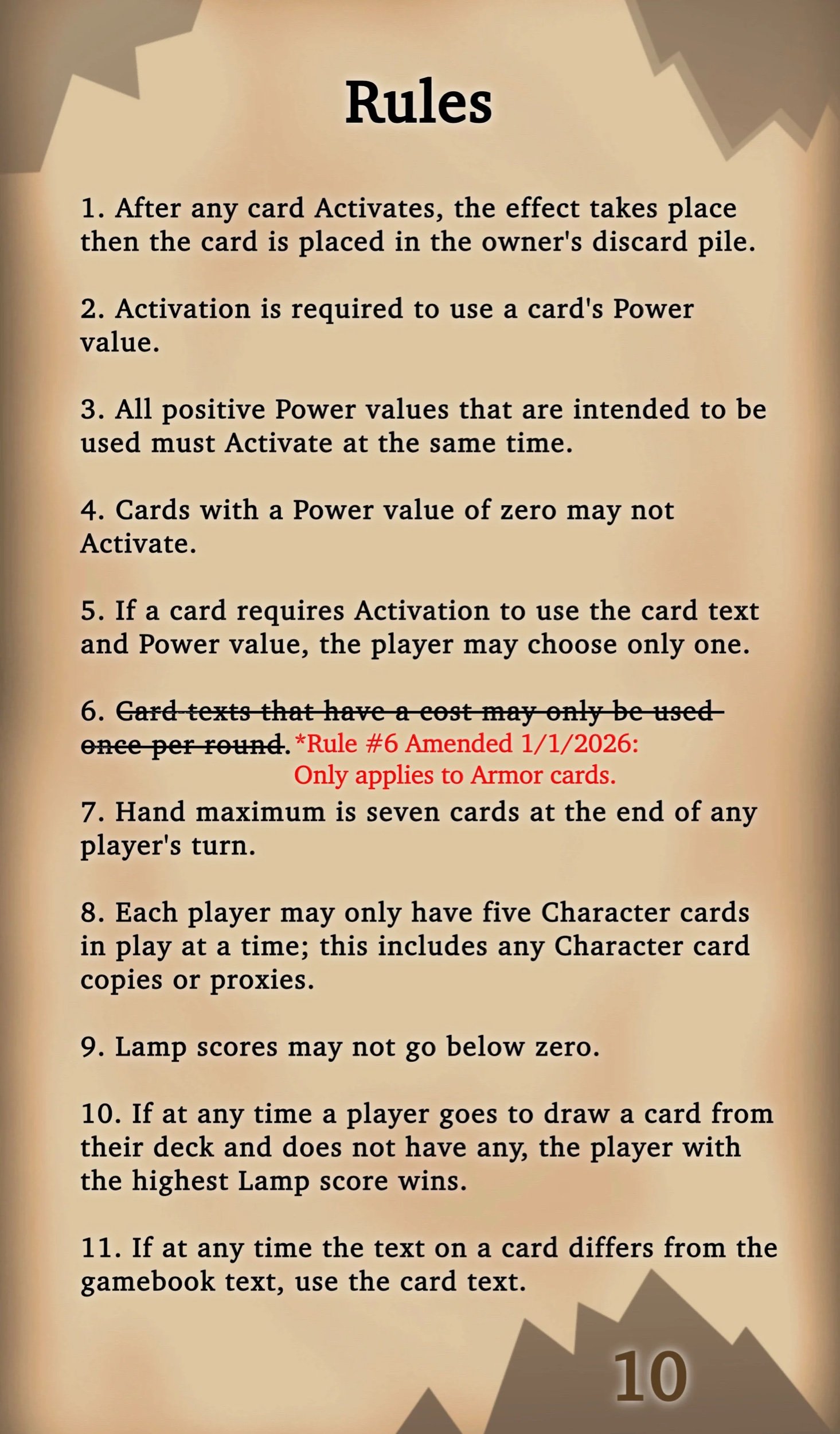
Activations (pushing a card forward on the play field) are required for the use of Power values and where activation icons are present before text in a card's ability text box.
All positive Power values must activate together on a player's turn.
All negative Power values must activate together on a responding player's turn.
If activation is required for use of an ability or another reason other than the use of Power values, they DO NOT need to activate together and may do so at any time.
Activations are considered an Any Turn play style in the speed with which they occur. After a card is activated for any reason, the effects take place and then the card is placed into the owner's discard pile.
Card Types:
"Unique" is simply a card type and means nothing other than the card is not the other card types. Generally, a Unique card type is given to a card because it does not fit into the other card types, it is just different; hence, Unique.
Card Play Styles & Action Sequencing:
Steady cards are played on your turn and stay in play.
Your Turn cards are played on your turn and DO NOT stay in play.
Any Turn cards are played on any player's turn and DO NOT stay in play.
Priority cards may be played on any turn and resolve first in the Queue (see below).
Activations are considered Any Turn/Your Turn play style and not Priority.
Activation to use positive Power values is assigned a Your Turn play style and must take place with any other Power values a player plans to use on their turn.
Activation to use negative Power values is assigned any Any Turn play style. In a more than two player game, the player to the left always has first choice to Activate a negative Power value, then the choice moves clockwise. Once a player chooses not to block by activating a negative Power value, they may not change their mind after the player to their left chooses.
Queue: After a card is played or a coin/token/die is moved, players have an opportunity to respond with their own action such as a card play or ability use. If a player responds with an action, that action may also be responded to - this creates an action queue or a stack of actions. Each action in the queue will resolve based on the final action and each associated play style.
Queue Example: Player "A" plays a Steady card, then player "B" uses an Any Turn card to send that card to the discard pile. Player "A" then chooses to Activate that card to use it's Power Value before the card goes into the discard pile. The last action in this example is the Activation, so the Activation happens and the Any Turn card from Player "A" has no effect and goes into their discard pile since the card was played into the queue. If the Any Turn card had been a Priority card, the Priority card would take place before the Activation. If the Priority card had been responded to with another Priority card, the last Priority card played will take effect first, then work backward through the queue.
Coins:
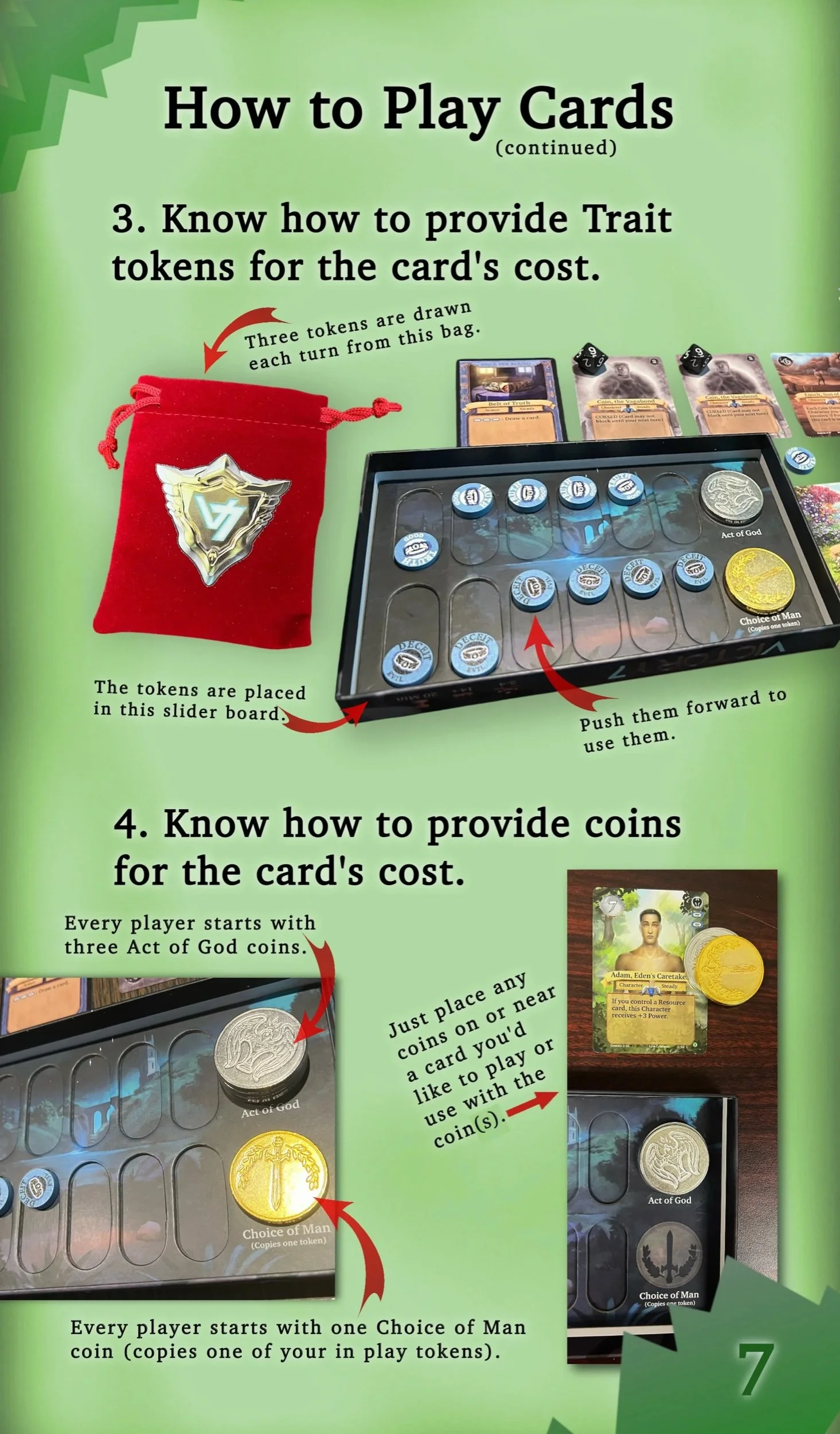
The Choice of Man coin is used to copy one of any trait token that a player already has in play.
Act of God coins are simply used to fulfill an Act of God requirement.
Generally, coins are used by taking from their starting/unused location and placing them on or near the card they are being used with or for.
Each player's coins reset on their respective Reset step of their turn.
Deck & Blind Bag Builds:
Deck must be 30 to 40 cards and may be 30 or 40 cards exactly.
Only three copies maximum of each card.
Each player may have one Armor card which is not included in the deck total. Players may have additional Armor cards in their Shelf. A player may use any Armor card with their build, but will need to provide the proper requirements that the card asks for in order to use its ability.
There must be six good and six evil trait tokens in your blind bag; a total of twelve exactly. The tokens do not have to be of the same trait type.
Shelves:
Shelves may be up to 10 cards & 6 trait tokens.
Players may add or exchange shelf cards/trait tokens between rounds.
Players may NOT remove cards from their deck to add to shelf only.
Players do not need a shelf.
Players CAN shelf Armor cards.
Shelves, decks, and trait tokens must be reset to original at the beginning of a new round.
Glossary:
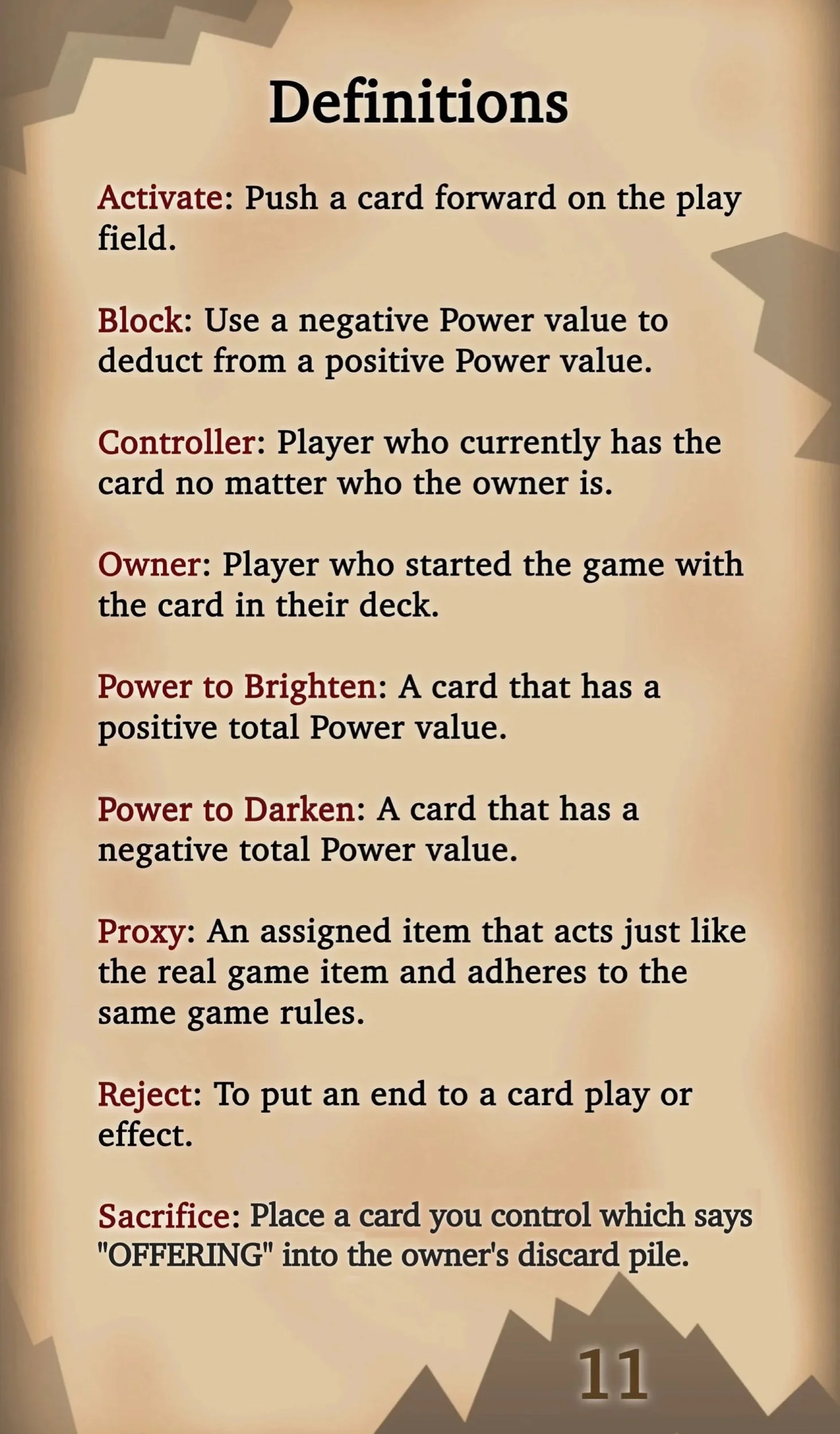
Activate/Activation: To move a card forward on the play field. Once moved forward, the effect which required activation takes place, then the card is placed into the owner's discard pile. Generally, activation is required to use a Power value or when the activation icon is shown prior to a card's ability text.
Control/Controller: To currently have a game item or card.
BLESSED (Feature Word): Affected by cards which affect BLESSED Characters.
BLINDED (Feature Word): Target player loses one good trait token for their next turn only.
Card Cost Area: The area on the upper right of a card which displays trait token or coin icons required to play the card.
CONFLICTED (Feature Word): Character may not use ability text.
CURSED (Feature Word): Card may not block until your next turn.
DOUBLE (Feature Word): Total Power value is doubled.
EXALTED (Feature Word): Target player loses one evil trait token for their next turn only.
Feature Word: A word in all CAPS within a cards text box that is associated with additional something that happens when the card is played or gives another ability. These feature words are generally proceeded by text in parentheses which states what the word means or does.
Floating: A term used to describe a game item or action which was produced, has no physicality and is currently unused.
INIQUITOUS (Feature Word): Character may not use Power value.
MAINTENANCE (Feature Word): Card maintains a specified requirement during a maintenance phase.
OFFERING (Feature Word): This card may be used with an "Altar" ability.
Owner: The player who started the game with the item or card.
Play: To place a card into your play field, except from another player's play field.
Play Field: The location in front of a player that holds game items and does not consist of the hand, discard pile, or trait token bag or its' contents.
RECOGNITION (Feature Word): If this card enters your discard pile, target player discards a card at random, then draws a card.
REWARD (Feature Word): If this card enters your discard pile, draw a card.
SPIRITUAL FORCE (Feature Word): Only cards with SPIRITUAL FORCE may block this card.
TENSION (Feature Word): Character cannot activate until the controller's next turn.
TIMED (Featured Word): Remains in play for a specified duration.
WEARY (Feature Word): Character requires one Choice of Man coin to activate. Clarification: A Choice of Man coin must be provided, NOT a trait token. This request for a Choice of Man coin.